Garage

Monday, 22 May 2017

Scientific history under threat by modern intellectuals

I have been trying to find a way to breach the subject of historical revisionism for a while. I have many discussions on YouTube where claims are made about logic, science and rational thought that are completely incorrect yet touted as fact.

If I was to ask most people how the modern scientific revolution began most people would give me a blank look. We in the west, including Europe owe a great deal to this amazing era and as such it deserves some attention. Now lets go through some of the key names and events that led to the enlightenment and the scientific revolution.

The birth of rationalism
Rene Descartes was born in 1596 and was a philosopher, mathematician and a scientist who would become a key figure in the inspiration of Newton himself. He introduced the concept of the Cartesian coordinate system and wrote the standard in philosophy called "Meditations on First Philosophy" which is still taught in philosophy departments today.


Of note was his work on rationalism - innate ideas, reason and deduction - the first half of the scientific method as it were. Interestingly, his work in developing his philosophy on rationalism would play an important role in the enlightenment and inspire many scientists and philosophers who would go on to develop entire fields of science. Many came to realize that we could think our way to truth and that by emphasizing the mind over the senses we could push the limits of what could be known through reason alone.

Empiricism and the scientific revolution
Francis Bacon (1561-1626) is a name most people have not heard. In a nutshell, he is the genius who came up with the first version of the scientific method as a tool of clearing away idols and false ideas in order to get to the truth.


Bacon played a key role in skepticism. Bacon was a fan of empirical evidence as he stated that, “the human understanding is like a false mirror, which, receiving rays irregularly, distorts and discolors the nature of things by mingling its own nature with it.”

Isaac Newton (1643 - 1727)
Newton's book Principia Mathematica is still considered to be a work of absolute genius. It was a description of the mechanistic principles seen in nature through the use of mathematics. For the first time, we could understand the world through with proof through mathematics.


We came to the realization for the first time that we and the universe itself was not random but rather governed by very intricate, rational mathematical laws. This concept is taken for granted today, but back then it provided brilliant minds evidence that the universe is indeed consistent and because of this, we can discover how nature works. This would go on to have enormous impact in the fields of biology, medicine and chemistry. This is why Newton is considered the father of modern science.

The Protestant Reformation
The Catholic Church used to have a monopoly on truth and was unwilling to bend - even in the light of evidence. The Protestant Reformation started by Martin Luther and continued by John Calvin caused the split of many churches from the Catholic Church and resulted in a friendlier climate for science to blossom.
The development of the printing press in 1451 by Johannes Gutenberg was revolutionary in that it allowed the rapid printing of books through movable type printing, the first book being the Gutenberg Bible.


This tool became instrumental in the printing and distribution of the Bible in people's native language. Before this, the Bible was only to be found in handwritten form in Latin. Only Catholic priests spoke Latin and so the remainder of the population remained in ignorance towards the will of God and the understanding of the written word. So grave was this threat to the monopoly of the Catholic Church that hundreds were gruesomely executed to try halt the Bible's advance throughout Europe. This of course failed and once people saw the corruption of the Catholic Church in light of a Bible they could understand, they became outspoken and the result was the Protestant Reformation. By 1482 there were 100 printing presses in Western Europe and by 1500 there were 40,000 editions of the Bible and the Greek classics with over 1,000,000 copies in print. This had a massive impact on the advancement of knowledge and we would not be where we are today without both Gutenberg's press and the Reformation it helped start.

The explosion of science
There was a remarkable explosion in science which began in Europe. Below you will find just a tiny list of notable names in science, many who were instrumental in developing entire branches of science:


Have you noticed?
The names above come from this page on Wikipedia:
Scientists
That's right. They were ALL Christians. Even those earlier in this blog post. The enlightenment was the result of Christian thinkers who were the result of the Protestant Reformation and the climate this created for science.
When I visit any Christian channel on YouTube, it is bombarded with comments from members of the atheist community who have somehow claimed logic and critical thinking as the mark of an atheist. The reality is that not a single atheist discovered anything of note during the scientific revolution. The entire movement was the sole consequence of Christians and their faith in God and the Bible.

So critical was this belief in God that even Newton said, 'Opposition to godliness is atheism in profession and idolatry in practice. Atheism is so senseless and odious to mankind that it never had many professors'
But how can this be? Newton is arguably one of the greatest minds that ever lived yet he had this to say about atheism? Maybe this is just a fluke though. What did other notables have to say about science and God?

"I believe that the more thoroughly science is studied, the further does it take us from anything comparable to atheism." - Lord William Kelvin

"Both religion and science require a belief in God. For believers, God is in the beginning, and for physicists He is at the end of all considerations... To the former He is the foundation, to the latter, the crown of the edifice of every generalized world view." - Max Planck

"The best data we have (concerning the Big Bang) are exactly what I would have predicted, had I nothing to go on but the five books of Moses, the Psalms, the Bible as a whole." - Arno Penzias

"To know the mighty works of God, to comprehend His wisdom and majesty and power; to appreciate, in degree, the wonderful workings of His laws, surely all this must be a pleasing and acceptable mode of worship to the Most High, to whom ignorance cannot be more grateful than knowledge." - Nicolas Copernicus

You see, the names on the list were not just labelled as Christians - they were devoted Christians and devout in their adhesion to God's Word. Their faith did not cripple their ability to understand the world around them - it was the very driving force and inspiration for why they studied the world and came to their findings. We turn a blind eye to this in modern society as it's a very inconvenient fact that modern educational institutions refuse to accept.

Standing on the shoulders of giants
The new atheist seeks to elevate and inflate the role of atheism in critical thought yet historically this "prerequisite" for critical thought does not even register as a blip in scientific history. When the point is raised that science as we know it is the result of Christians EXCLUSIVELY, this is written off as a mere coincidence or the argument of "the church was mean to Galileo" is thrown around.

Unfortunately, you cannot separate the faith of the founders of science from their brilliance as they themselves are quoted as giving God the credit for their inspiration. In fact, it's because they knew God through his Word and his orderly nature that they expected to find order and laws in nature. This flies in the face of every other religion where the god(s) were fallible and whimsical and inconsistent. In fact if one were to take atheism to it's logical conclusion then there is absolutely no reason why we should observe consistency in nature at all.

So how can we stand on the shoulders of giants yet completely ignore the very foundation on which those giants stand? Because when it all boils down to it, we are not as logical and critical as we like to think. We like to claim the discoveries yet refuse to acknowledge how these discoveries came about as it upsets our world view and calls the very fabric of our reality into question. There is no conflict between faith and science - merely conflict between atheism and the faith that started and stands with science.

This is why in order to continue the new atheist argument, history itself must be changed as when we really understand how we got here, atheism makes less and less sense.

I would urge you to watch this excellent debate between David Wood and Michael Shermer which covers this beautifully.






Tuesday, 13 October 2015

Planned Parenthood Selling Bodyparts of Children

It was a conscious decision of mine to avoid polarizing and political topics on my blog. My opinion was that life is serious enough without adding to it in my blog, however in the last week and with a great deal of thought, I have decided to write about one of the most difficult topics out there. Abortion.

I would urge that you read this whole blog post. You may want to skip the videos due to their extremely disturbing nature, but please bear with me as this subject deserves some critical thought. I have spent a great deal of time chewing this over and believe that we need to visit this topic as rational, critical thinking people to give it the thought it deserves.

It probably comes as no suprise to the more discerning readers that there has been a flood of activity around this topic with the recent videos exposing planned parenthood and the body-part trafficing of the organization:


What has shocked me most about this is how cool and calm these people are talking about the sale of body parts of the unborn, not unlike serial killers or mass murderers who demonstrate that they have no conscience. As Stalin was rumored to have said, "A single death is a tragedy; a million deaths is a statistic." They have stopped thinking about who they are eliminating in order to make their profits and not considering the carnage they leave in their wake.


The process of killing the conscience with semantics and definitions
I don't know which side of this debate you are on. All I can give you is my experience and apply some logic to this argument. As a firefighter, my job was to preserve life, born or unborn. This was often done at great personal risk both to myself and the brave men I worked with. We worked with a conviction that all human life had value and if that life happened to be unborn, then it was even more helpless and this brought on a sense of urgency that was rarely found in any other emergency we attended. I have witnessed people willing to run into a burning house to save their precious children who were considered lost and with no hope of survival, yet these parents were willing to risk pain, permanent injury and likely death for the chance to save a child who was most likely dead or so seriosuly damaged they had no chance of a "quality life" as so many people put it.

On one hand as firfighters and EMT's we are told that life, even unborn if priceless and of infinate value, on the other hand as regualr citizens we are told that choice trumps life and in fact that a fetus isn't even alive. I mean, if you knew that what was growing in the womb was actually a living human being, could you carry out this type of procedure?


So how do organizations like planned parenthood define life? Well, when asked when life begins, Cecile Richards, the President of Planned Parenthood Action Fund said, “It’s not something that I feel is really part of this conversation…every woman needs to make their own decision.”

How is this not part of the conversation? If life has already begun when they carry out this procedure, wouldn't that be murder? If it has not begun, then why do they need to sever the head from the body, stab the face with a scalpel or cut through the spinal cord to stop the heart beating and the unborn from moving if it is already dead?

You see, it's far easier to convince people that abortion is morally defensible if you avoid this conversation altogether and focus on the choice of the woman.

An uncomfortable parallel
For many young people these days, the regimes of Pol Pot, Mao and Stalin are nothing more than forgotten history. Yet these regimes put no value on the weak, the old, the infirm and the unborn. It was not strange for evil men like Hitler or Stalin to insist that inferior genetic examples like those with down syndrome, gypsies, Jews or the old were eliminated. In fact, definitions were provided by the state and it's scientists in most cases to ensure people could rationalize that they were not dealing with actual humans, but rather something inferior, something of no value. This allowed Hitler to kill millions, and Stalin tens of millions, perfectly legally of course.

But surely their argument is justified? Because at the end of the day, they were protecting their entire national community from genetic inferiority and poor health and those they disposed of from a poor quality of life. This is a much more noble cause than the free choice of just one pregnant teenager afterall. So why on earth did we execute these Nazis at the Nuremburg trial for carrying out something so noble, so valiant and something entirely legal if we apply the same standards applied to abortion? Why were their actions seen as morally reprehensable, and yet those actions of planned parenthood and similar organizations are seen as just offering someone freedom? Maybe it is because we have swept all this under the carpet, ignoring logic and moral consistancy, and rather focus on the virtues of abortion and the need for choice. This video makes the comparison perfectly:


The argument often used is that these fetuses provide life saving material and as such, the disposal of these unborn children is somewhat justified.

Inconsistent definitions
At this point, the argument for what defines life is usually brought up again. I mean, if science does not define a fetus as alive, then why should we feel guilty about allowing thousands of unborn, non-living clumps of tissue to be crushed, torn apart and sold?

Science is quite hypocritical on this issue. With all the recent activity with the exploration of Mars, scientists are looking for signs of life on the planet. NASA would be thrilled to find microbes in order to prove life exists on Mars:

Nasa and life on Mars

So Microbes are considered life, yet a fetus at up to the age of 24  weeks is not. I would urge you to click the below link to see images of fetuses aborted at 24 weeks, not for some sick, twisted reason, but because someone owes it to these kids who's parents have been duped into thinking they are not alive, have been aborted and afterwards sold as nothing more than meat:

24 week old fetus

Science and State, the standard for moral bankruptcy
So here we are at a moral crossroads. Do we choose science and the state to decide for us what is morally right, or do we use logic and the premise that all human life is intrinsically valuable? If you may have noticed, I have left choice out of this argument completely, because I don't believe that morality should be swayed by the rights of the strong to choose over the weak.

Throughout my career I have chosen employment that has saved, educated and built up those around me. I have worked in special needs classrooms and have conducted physical therapy on children physically deformed, many of who were adopted and loved as much as one could possibly be loved. They led full lives and were valuable not just to their parents, but also to people like myself who learned that life is richer giving to those who don't have, and protecting those who can't protect themselves.

I would urge all who read this to think critically about this issue and ask themselves, "At what age is it ok to kill a toddler?" If you find this question disturbing, then you cannot morally justify the killing of a fetus that can just as easily be proven to be a living, human child just waiting to be born.

Where do we go from here?

The only thing necessary for the triumph of evil is for good men to do nothing.
- Edmund Burke -

Who will speak for those who have no voice? Who will tell these young mothers that have been convinced that they are just removing a clump of cells that there is hope and help available?

If none of what I have written has disturbed you or pricked your heart, then you need to do some soul searching. At what point did we become so cold and morally bankrupt that we ever bought into this pack of lies, that killing the weak and helpless for any reason, no matter how noble we may think it is is morally justified? How is this justifiable now that we know that their tiny bodies are being sold by those touting the virtues of abortion?

I would urge you to look into this issue deeper and to start asking the questions most people don't. You may find that it may cause some heated discussion, but you may also find that you may save the lives of those who nobody was willing to fight for.

Tuesday, 25 August 2015

Making a shipping container into a workshop

We recently sold our house and I was left with the dilemma of organizing a new workshop. We didn't want to buy a place as the oil prices are looking pretty shaky so this limited our options regarding a permanent garage solution since both my wife and I work in the oil industry.

My wife made the suggestion of using a container as a workshop and at first I wasn't sure about the idea. The more I thought about it the more the idea grew on me. The only problem was that in order to have the workshop usable and stable enough for the machines it had to be insulated and heated. This meant a great deal of work would have to be done.

Buying a container
In Norway we are limited regarding the choice of container suppliers. We decided on a company as their price was OK and delivery was cheap as the container was found locally. What should have been an easy process turned out to be a complete farce. The company representative would not call back, didn't communicate regarding delivery, the delivery was late, the driver dumped the container in the yard in the wrong spot and not on the concrete blocks prepared for the container, then we were issued a bill for the container and delivery that was 20% above the agreed the price. Once we provided our correspondence as evidence of the agreed price and paid the bill, the sales guy went on sick leave and then we started getting hassled by another sales representative and needed to spend hours resolving debt collector letters for a bill we had paid.
But that's history.

The container in the yard:


Planning
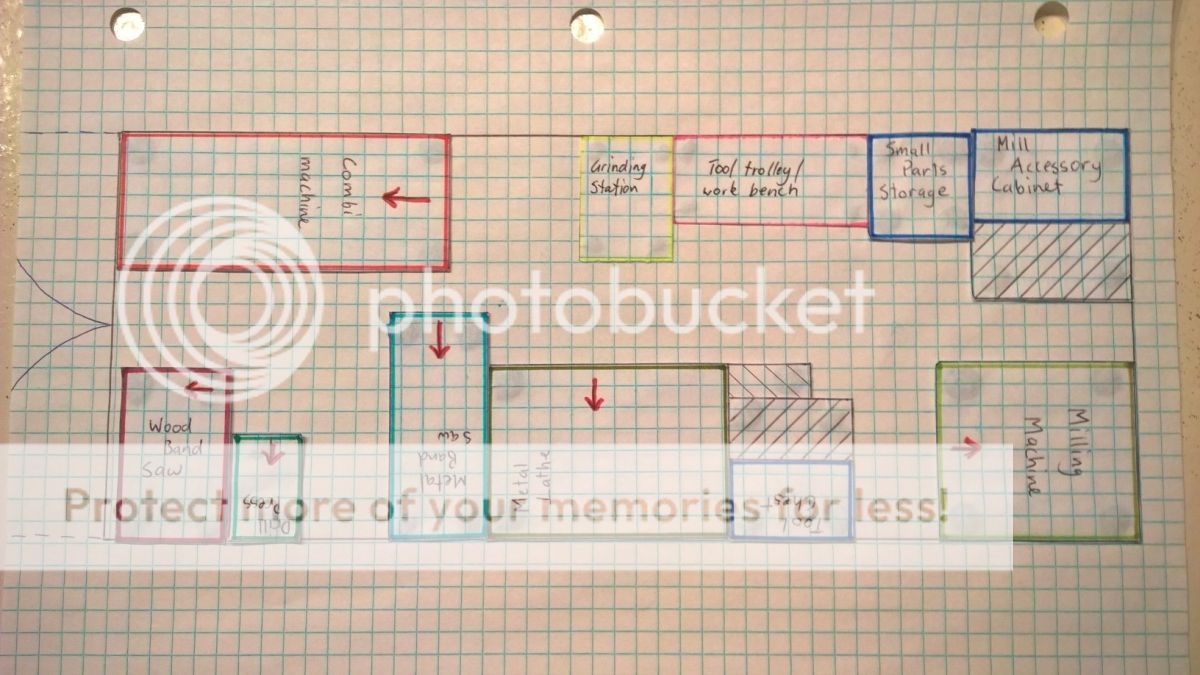
When undertaking a project like this, you really need to have a good plan regarding how you will utilize the space. If you don't spend time working through the floor plan and your storage solutions, then you will have a difficult time later. I made several plans early in the project:

Plan 1:
 Plan 2:
Final floor plan:

Planning the floor space allows you to start figuring out the electrical layout, what type of materials you want to use and probably most importantly, what you need to get rid of. In such a tight space, you need to be brutally honest about what you will use and will have to purge a great deal of "rainy day" equipment and materials.

Materials for insulating a shipping container
Since the floor space is so limited, I didn't have the luxury of selecting thick insulation. Instead I opted for 50mm styrofoam plates for the ceiling, and 20mm thick panels for the walls. I also opted to use 9mm thick plywood for the walls as it would allow me to fasten items to the walls.

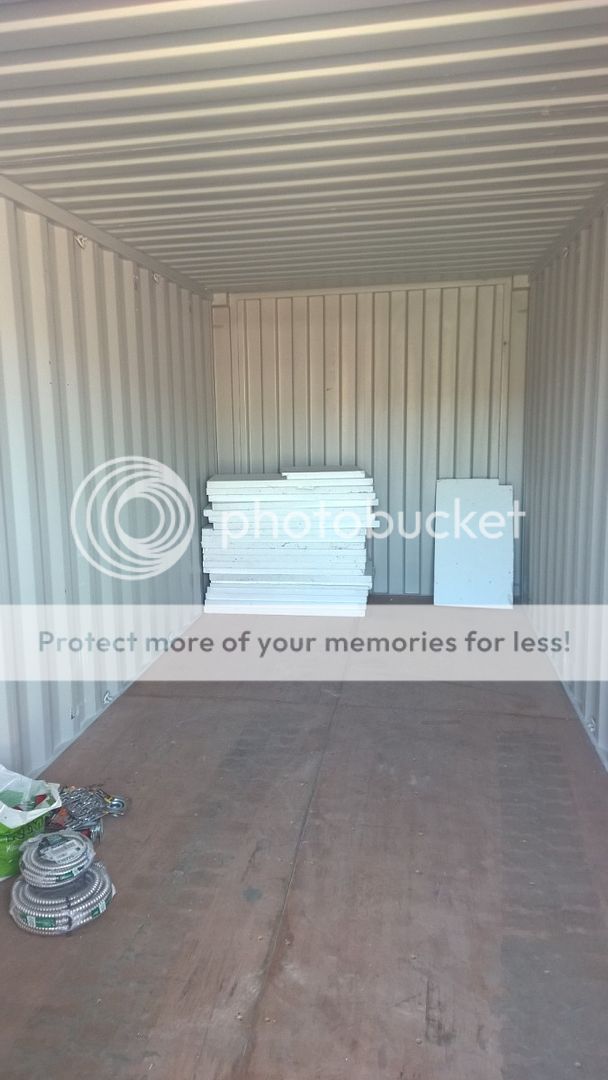
I managed to pick up the ceiling insulation quite cheap as it was used. Fortunately, I had exactly enough for the ceiling:

The idea behind the workshop was to make it transportable, meaning that I had to have a means of fastening the machines to the floor. I opted to add an extra layer of waterproof ply 21mm thick to the floor that would allow me to install enough recessed pan fittings into the floor to hold the machines in place.

The journey begins in ernest
I started to pick up all the materials and get ready for the installation of the floor.


I had also decided on the installation of a rolling bridge crane since the workspace would be tight. I didn't want to try edge heavy objects past my vintage machines so when I found some H beams that were 100mm x 100mm, I jumped at them and stored them away for the time being.


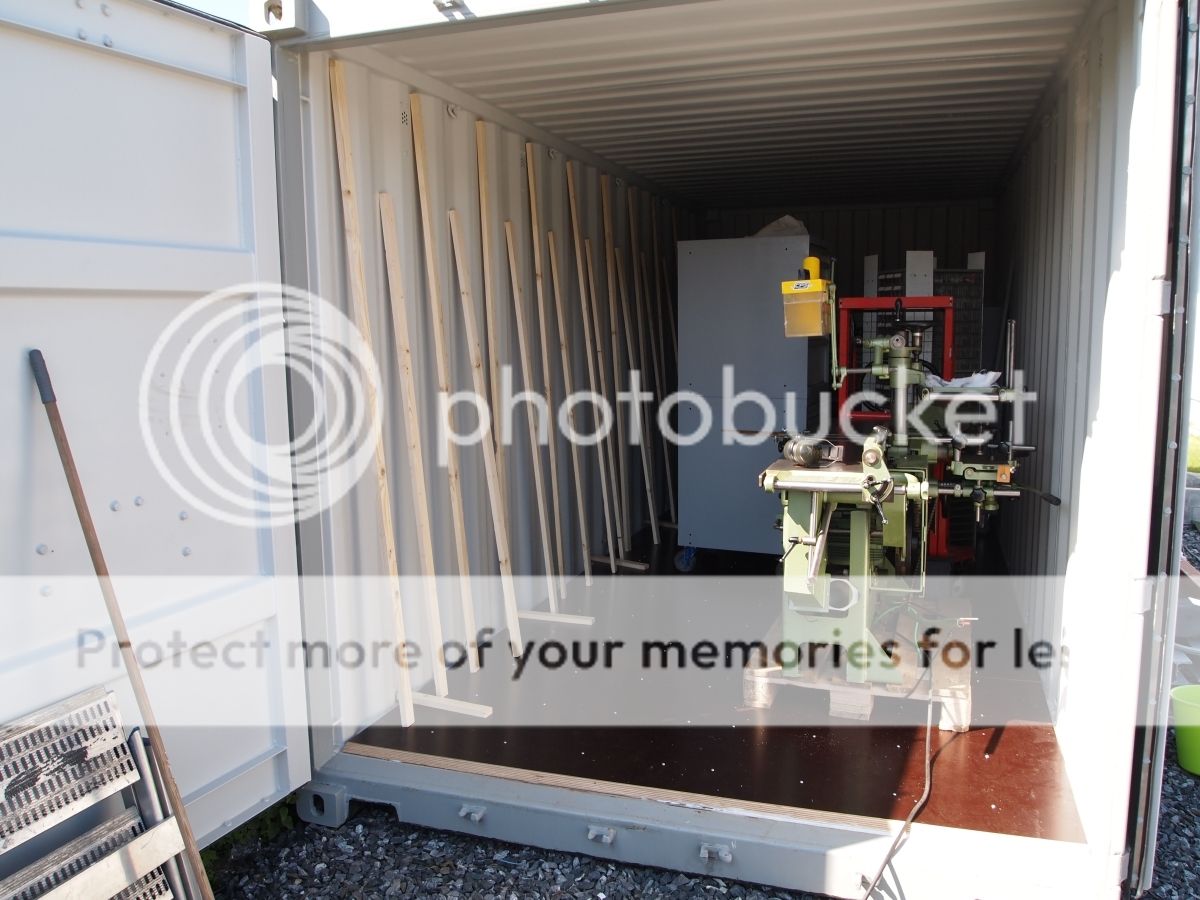
For this project, glue was a critical item. In order to maintain the shipping certification of the container, no holes could be made in the container meaning that other than the floor, I was not able to screw into the container. I needed to make sure the glue was sufficiently strong so opted for a solution for the walls that would have vertical and horizontal support. This required me to rip down the studs for the walls so I needed to pick up my combination machine as the 3 hp motor would make short work of the hundreds of meters needed for the walls and the ceilings. I just needed to install the floor first as the machine is very heavy and I needed the manual pallet jack to move it about...

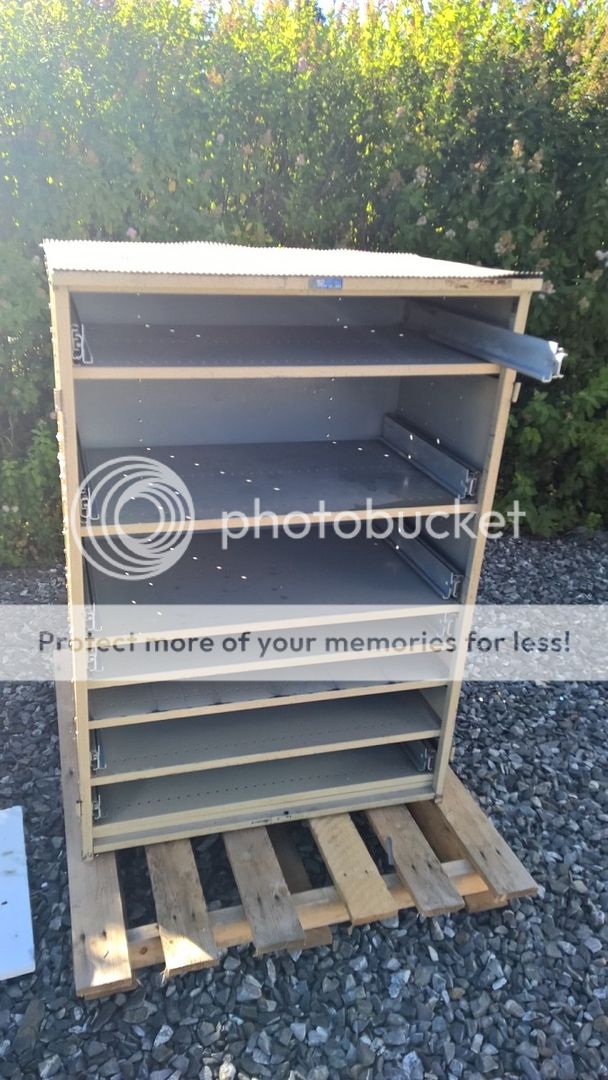
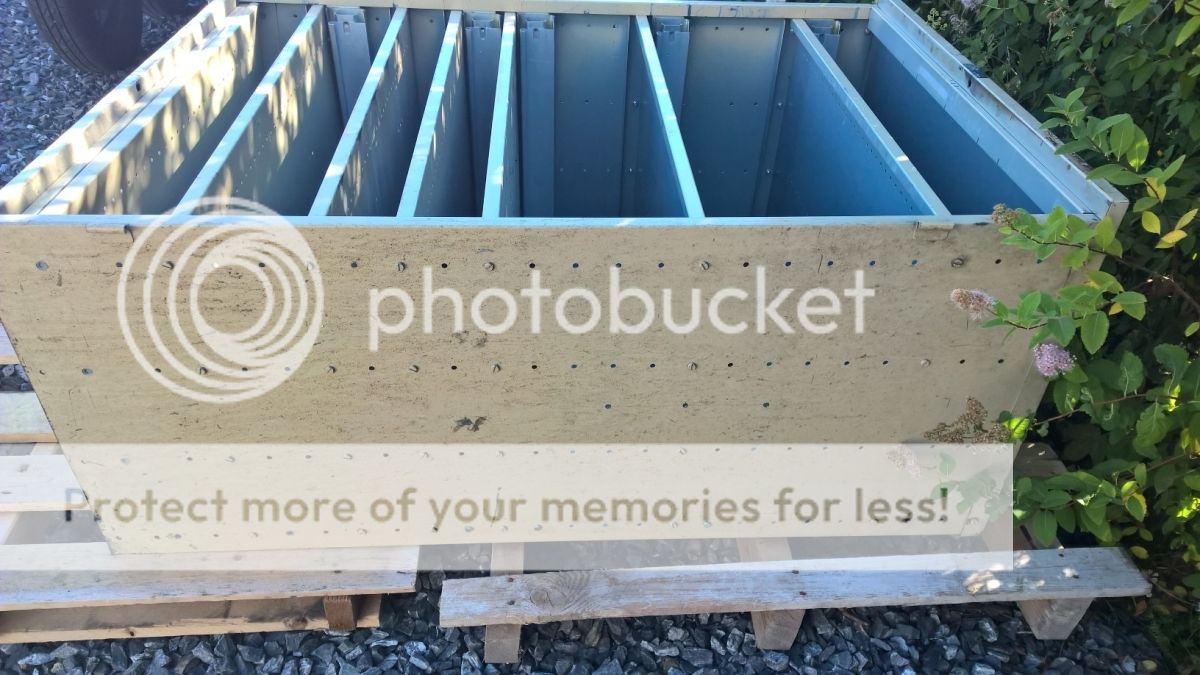
While I was working on the floor solution, I came across some Lister metal cabinets from the old SAS service department here in Norway. I bought them for  a good price so in the downtime when I couldn't work on the container, I worked on repainting and straightening out the cabinets as they would be a huge space saver in the workshop. My final floor plan was then made based on the purchase of these cabinets and a work trolley that would be my new work desk:


I was trying to complete this project on quite a tight budget so these cabinets and trolley were purchased at a very reduced price. They allowed me to increase my storage capacity significantly so I thought they were worth the investment. Inbetween planning and fetching materials, I worked on freshening up the cabinets:


After the slight detour and distraction with the cabinets, I installed the floor and started on the walls.


My yard was really looking like a construction zone at this point.


I had chosen to glue in the walls studs, then glue on wooden skirting boards. I wanted to have access to the tie-downs so I made sure to leave them exposed. When I glued  the styrofoam onto the walls, I temporarily removed some cut-outs as I didn't have the correct sized holes saw:


At this point I realized that pre-painting would be wise so I selected my colour scheme and bought the paint I needed. I opted for loight grey for the walls and for the same colour blue as the cabinet drawers for the horizontal wooden supports.


The container is not a precision item
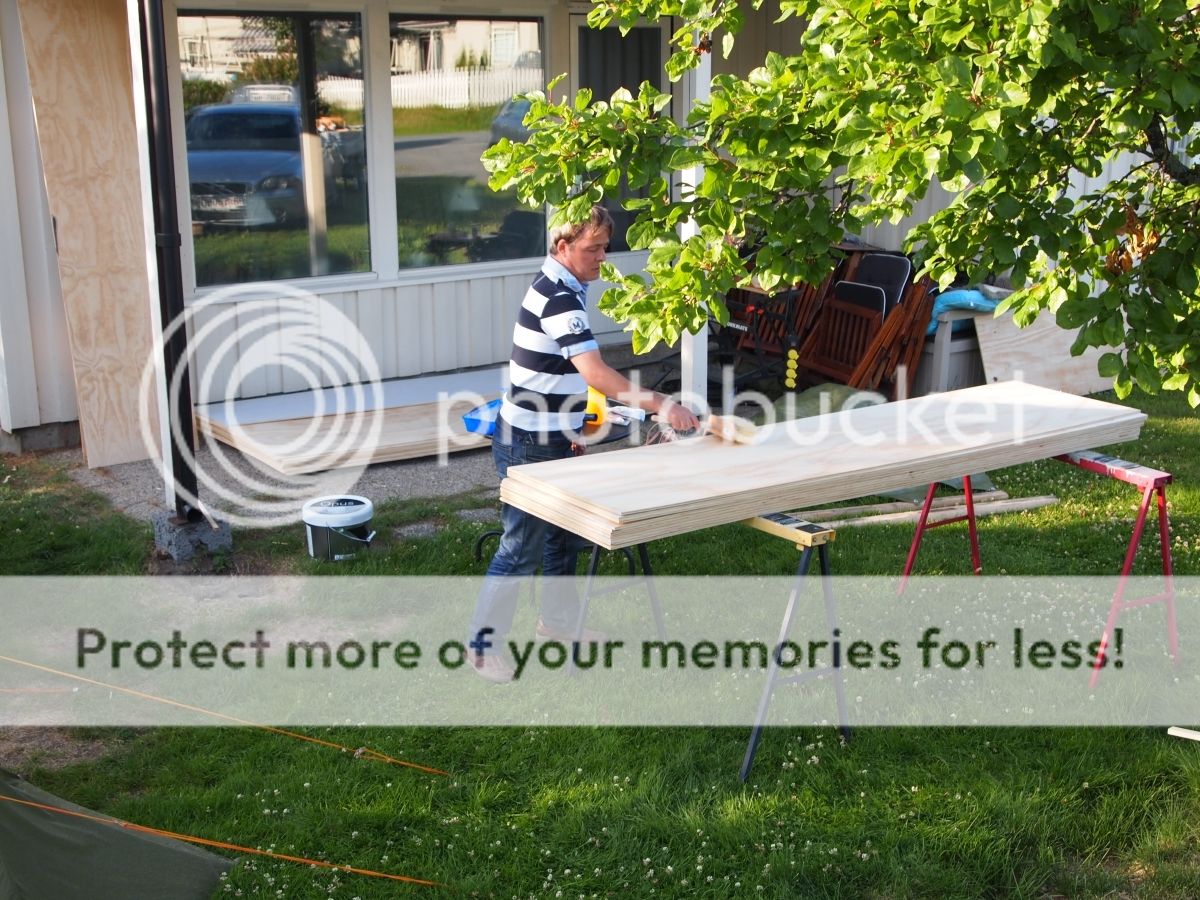
It may suprise you but containers are not built to the finest tolerances. If you choose to undertake this kind of project, make sure you have access to an electric planer. This will help you get the walls somewhat straight. I spent some time prepainting the wall panels and the horizontal supports as it didn't matter if I got blue paint onto the styrofoam insulation as it would be covered by the ply panels:


At this point I had also picked up my larger hole saw and was able to cut out the tie-downs to allow better access:


I was very fortunate as I had the help of some very good friends with the painting, sheeting the walls and general installation. They also helped me with the floor and without this father and son team, I would not have been able to complete this project:


The ceiling and crane rails
I got to a point where I was not able to go further with insulating the walls or ceiling as I needed to install the crane rails. For this I needed to cut the H beams and weld them, attach brackets and then weld the completed rails to the corner members of the container. I needed my metal bandsaw for this so I had to drive back to my old garage and pick it up. My neighbour Kato was nice enough to lend me some 3 phase power for the saw and in no time we had the materials cut and container ready with the attachment points ground and ready for welding:


My landlord who is a welder by trade came and did the welding for me one afternoon and with Kato, Oreste, Nathan, Frank (my landlord) and I, we installed the rails:


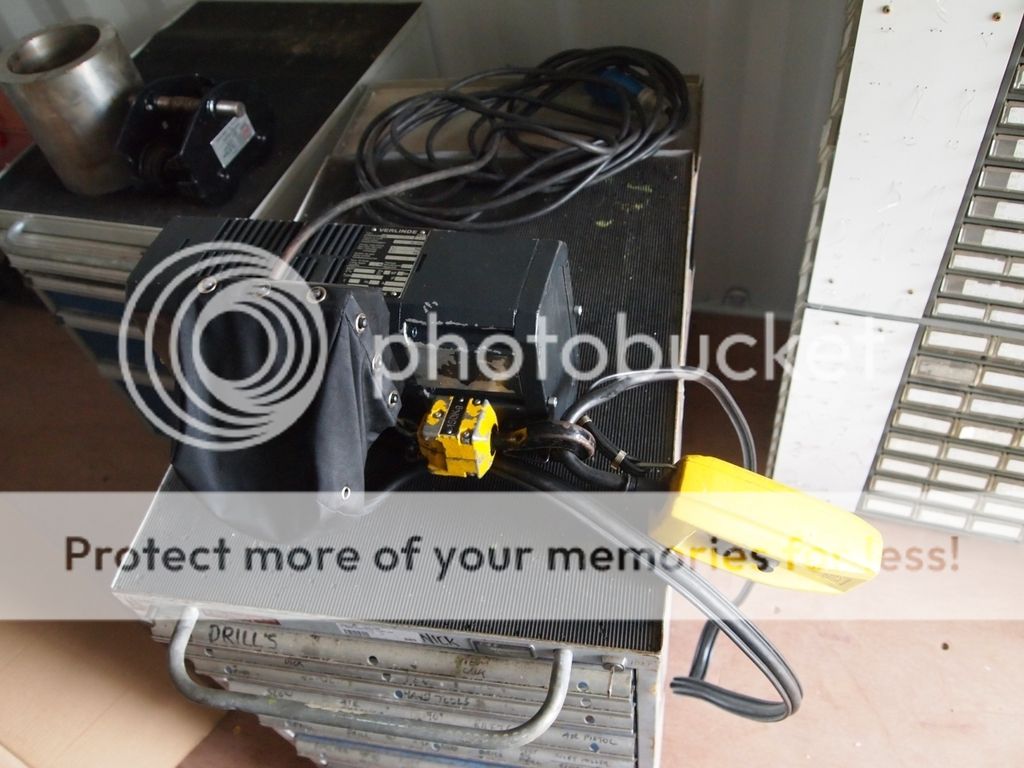
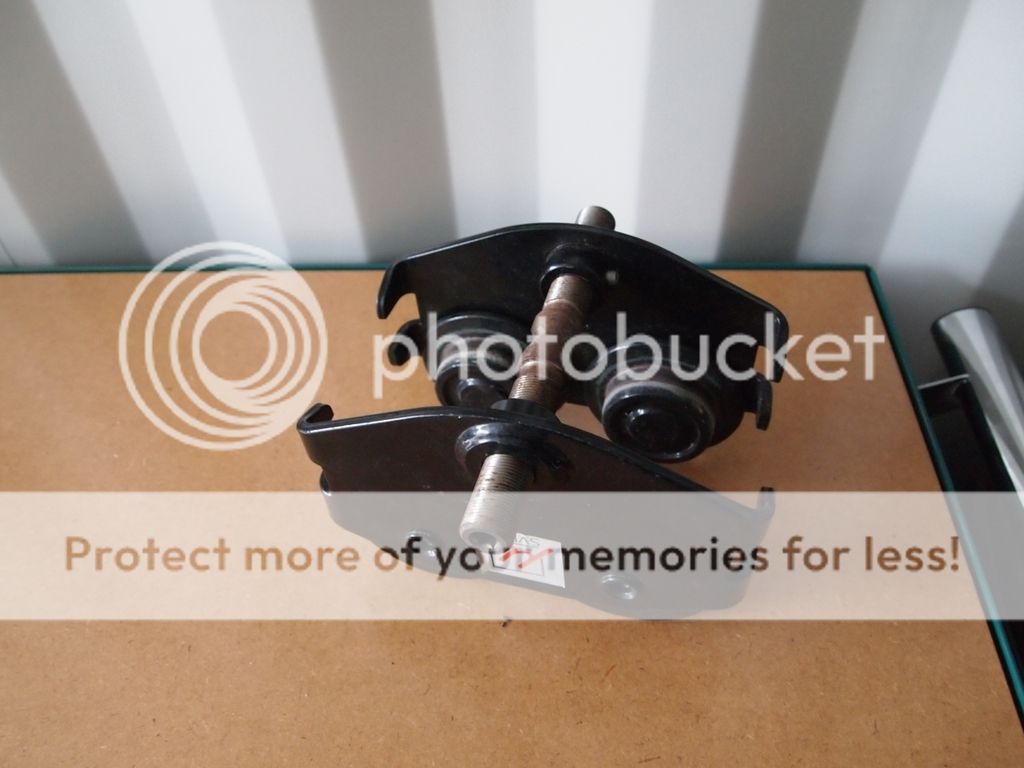
The crane will only be lifting 150kg so this setup is plenty strong enough to support it. I had also purchased an electric chain winch and trolley for a really good price early in the project so I was pretty keen to see this come together:


Let there be light!
With the rails up, I was able to finish sheeting up the walls and the roof, and was able to install some basic power. I had to drill some ventilation holes to allow the air to circulate and I also painted the rails with zink primer.


With power installed I was then able to continue working on the container inside even when the weather was terrible. We had a bad summer so there was rain on and off the whole time and I was having to work under a tent with the ply as it would warp when wet. I began installing tool boards and purchased a construction site breaker box in preperation for the installation of the rotary phase converter.

Unlimited power!!!!
At this point in the project I made the decision to install a rotary phase converter. I needed 3 phase and despite Kato being the nicest guy in the world and wanting to help me, I wanted to have my own power on and would eventually have to do this anyway. My friend Bjorn made a rotary phase converter with a 4 kW motor and we organized a trade. I needed to build a cabinet and house it properly.
While I waited for Bjorn to bring the RPC to work, I installed the rest of the power points and cabling with my friend Pete. He is an electrician by trade and a perfectionist so we speak the same language. I think his work speaks for itself:


At this point Bjorn showed up with the goods so I got to making the cabinet.


I will be prettying up the cabinet a little more but for the time being it is sound proofed and has vent holes to prevent overheating. I need to revise the cooling solution as it runs a little hot when on for extended periods but I am pretty sure I have a simple solution to the problem.

It's the small things...
With the RPC installed and working, I wanted to start organizing the rest of the container. I put up my main tool board and began positioning the cabinets and tool trolley in their final position. I had also been working on cleaning up my small parts storage as I had to remove the sticky labels and there were about 400 to remove.


I installed the laptop bracket and had a laptop donated by a colleague at work. I still needed to cut some bench tops and drawer inserts from the excess plywood I had laying around.

I installed a white board to allow me to make sketches and do basic design work in the workshop.


I also got around to repairing the emergency stop on the drill press which had been missing since I bought it a couple of years ago.


Would you keep it down?
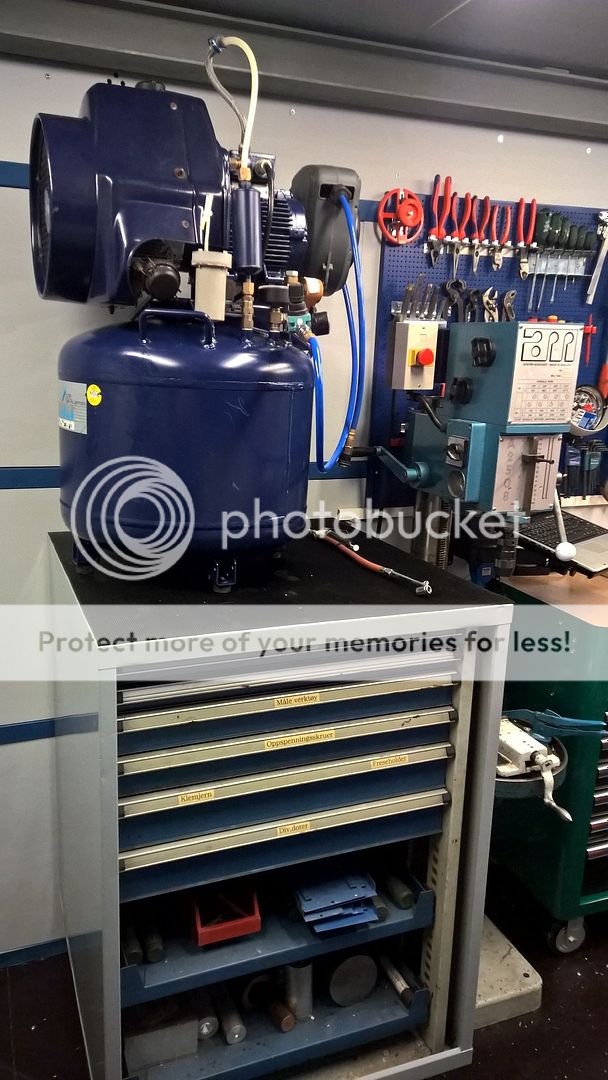
In such a confined space, noise can be a real problem. I have a really nice compressor (an Italian SIP) however it is a single cylinder unit and makes an awful racket when running. I happened to find a nice dental compressor for a very reasonable price and picked it up. It needed some TLC and a couple items made but once I had cleaned her up and added some new bits, I was able to install it and have shop air available.


Dealing with the big items
Now that I was nearing completion of the biggest things in the workshop, I needed to start moving some of my bigger items in. I had a milling machine cabinet that weighed a ton and was in pretty sad shape. I needed to have this straightened out and painted before setting it in place. I also needed to mount it on wheels. I picked it up on a Monday afternoon and the following Tuesday was such good weather, I cashed in some flextime in order to get it painted and installed.


The bottom of the cabinet had a frown caused by someone lifting it with a forklift while fully loaded. I needed to disassemble it, straighten it out and remove the dents and contact cement used to adhere the rubber matt to the top of the container.


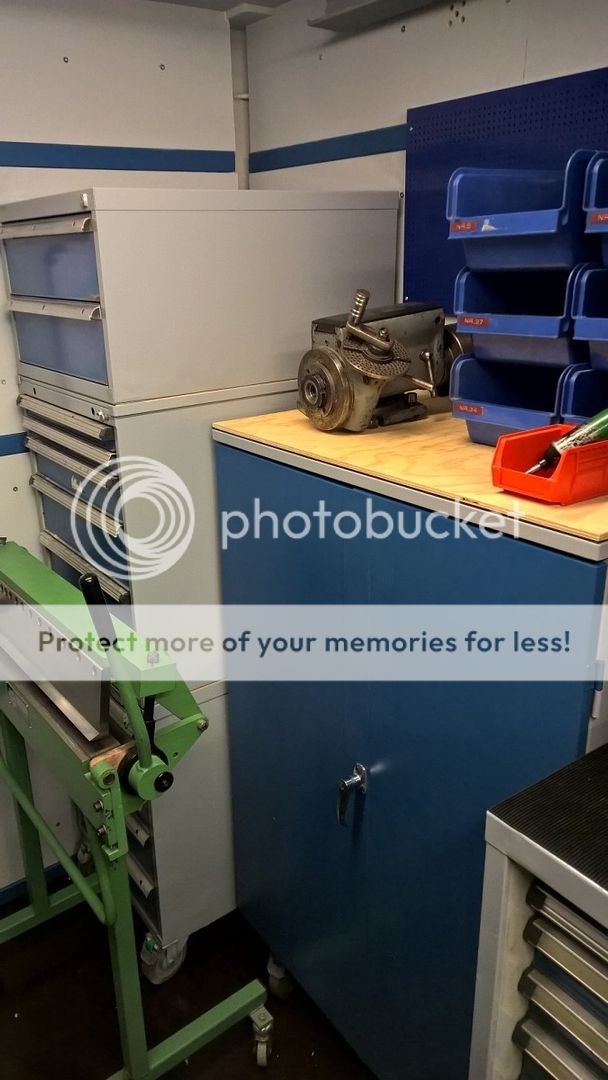
This literally took the whole day. 2 coats of paint later and this was the result:


The doors now closed properly and it was far more stable than before. I also cut new drawer inserts from the 9mm plywood left over from the walls as the originals were 24 mm thick and used up far too much drawer space.

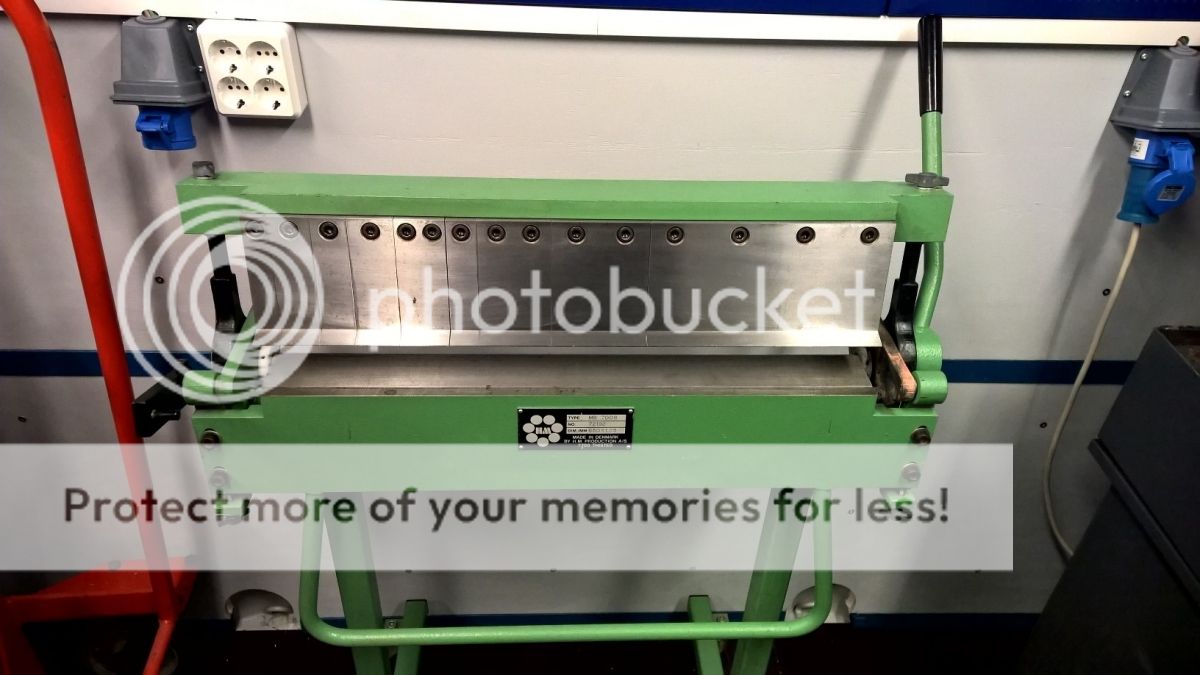
While I was working on the cabinet, I kept thinking about all the brackets I needed to make and how I would go about getting them bent to shape. I regularly check the Norwegian version of Craigslist and came across an ad for a finger brake. It looked a little rough but it was Danish made and the price was right:


It would handle up to 18 guage metal and was small enough to be able to fit into the workshop so I picked it up and gave her a bit of a clean. It turned out to be in far better shape than I expected and the majority of the marks were where some grub had stubbed out his cigarettes on the machine. A cotton cloth and some Jif later and this little beauty was looking good. These sheet benders are VERY expensive to buy normally and had it not looked sad, It would have sold for far more than I paid for it.


With the finger brake I could make supports for the cabinet which allowed me to remove stretched metal and then brace it up with specially made brackets. This made the cabinet far stronger and more stable.

I had arranged to pick up my lathe, mill and bandsaw with my friend Bjorn on the weekend. He would bring a trailer, straps, a chain hoist and a wooden frame so we could lift the lathe onto a pallet, and I would bring the high lift pallet jack and another trailer.

With the wooden frame we were able to get the lathe loaded onto a pallet and then we used the pallet jack to load the machines onto the trailers.


I had arranged with Frank to have a tractor waiting for us, so when we arrived he rang Per and we began unloading and getting things into the workshop.


We took it slow and steady and supported the machines by hand as the tractor moved them off the trailers and into the container at a snail's pace. Both Frank and Per didn't think everything would fit but we got everything in with centermeters to spare!

The final result (nearly)


So as you can see, I am nearly done. I still have to make the crane, move the lathe off the pallet and get some shelves and accessories mounted on the walls. I also need to make some rolling bases for the bandsaw and combination machine, and make a deck on which I can roll the woodworking machines onto. I will continue to chip away at this and slowly organize the drawers and cabinets so that I can start to find items again.

This has been a project that has taken 5 weeks so far. If the weather holds out I expect that I will be done completely in about 4 more weeks since I am now off the summer break and need to squeeze everything into afternoons and weekends.

I hope you enjoyed this journey and stay tuned for more updates.